
Arrest Warrants in Murray County
A Minnesota judge does not sign a criminal arrest warrant on a hunch. Rule 3.01 requires probable cause first, drawn from a complaint, supporting papers, or sworn testimony. The rule also leans the other way by default. A summons comes first, and a warrant goes out only when a listed exception fits. Maybe the person seems unlikely to show up, or no one can find where they live, or someone faces imminent harm. That is why two nearly identical charges can end differently in Murray County. One defendant gets a notice in the mail. The other gets an active warrant, and law enforcement is directed to arrest that person and bring them before a judge.
Probable Cause and the Affidavit Behind a Murray County Arrest Warrant
Behind every Murray County arrest warrant sits paperwork in two parts. The complaint is the charging document. The affidavit is the sworn statement backing it up, and a judge reads both before signing anything. Court Administration holds the finished file, though a public view may show the charge while holding back supporting pages. A charge label alone tells you nothing about how the case will end. Minnesota Rule of Criminal Procedure 3 spells out both paths, the summons and the warrant.
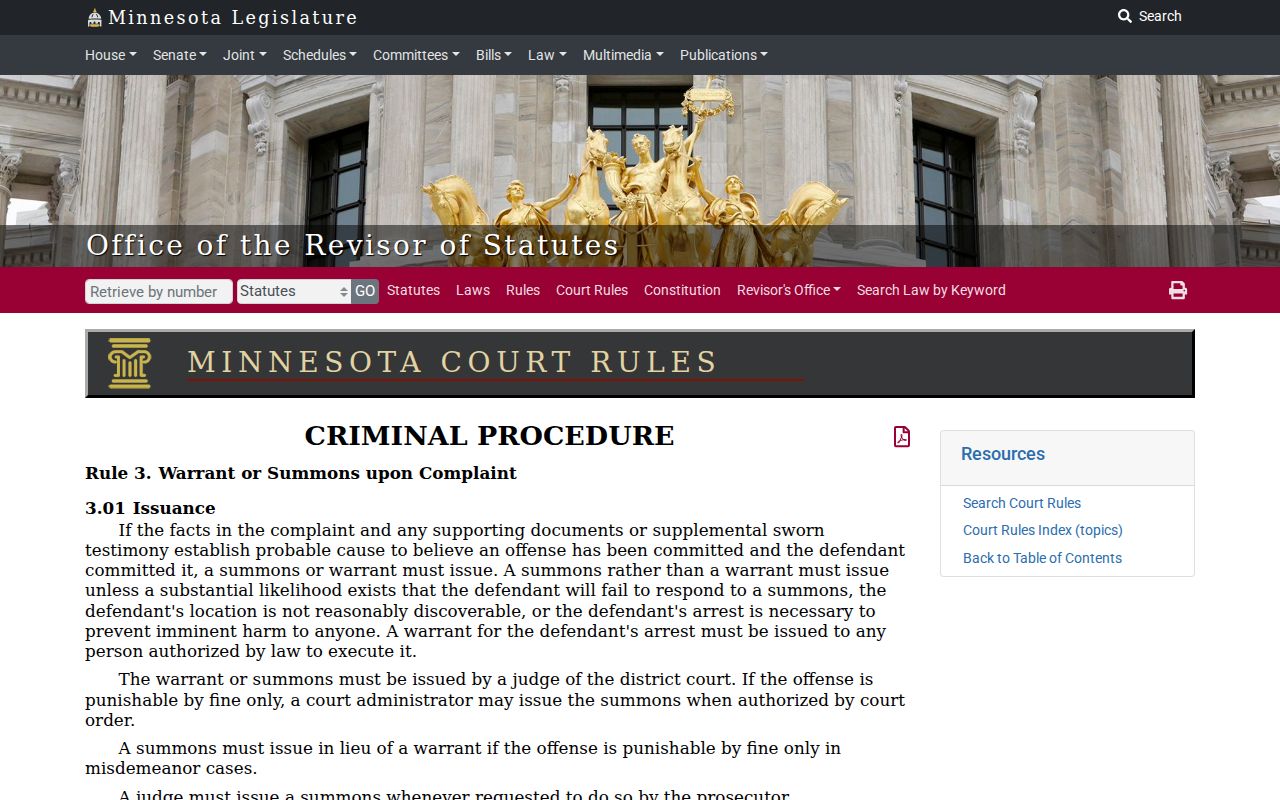
The rule shows why the same facts can produce either document.
What a Murray County Arrest Warrant Contains
A Murray County warrant is a short order. It names the person, lists the charge, identifies the court, and tells officers what to do.
| Defendant name | The person named in the complaint and the order. |
|---|---|
| Alleged offense | The charge and its classification from the complaint. |
| Court and file number | Murray County District Court and the case identifier, in the pattern 51-CR-26-0000. |
| Judicial authorization | The judge's signature or electronic authorization with the date. |
| Arrest direction | The instruction to take the person into custody and bring them before a judge. |
| Bond or release | Any amount or condition the court set, or nothing at all. |
No bond figure on the record means exactly that. It does not promise release without conditions.
Why a Murray County Warrant Index Can Stay Closed
Minnesota keeps court files and law-enforcement warrant indexes separate. Under Minn. Stat. § 13.82, subdivision 19, an index entry stays closed. It opens only when the defendant is in custody, is served, or appears in a Murray County courtroom.
Key Rules:
An unserved warrant can be withheld from public view while the court file stays open.
Active investigative data can be protected under a separate subdivision.
A missing online entry is not a clearance.
Minn. Stat. § 299C.115 makes counties feed warrant data into a criminal-justice network. That network is not a public search tool.
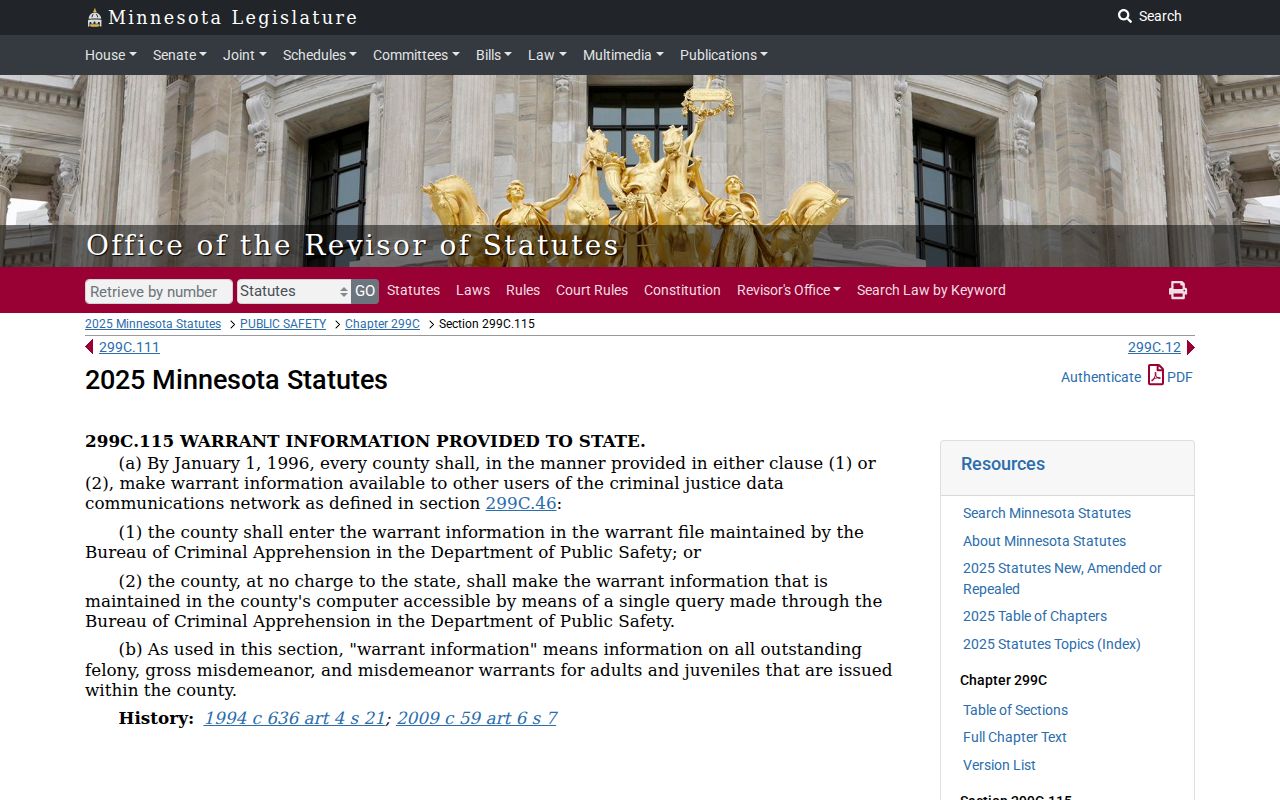
Police work is what the network serves. For Murray County, the public route runs through the court and the Sheriff.
How Murray County Arrest Warrants Are Served
More than one agency can serve a Murray County warrant. The Sheriff's Office is the county contact for warrant service. Slayton and Fulda each run their own police departments, while the other seven cities buy police service from the Sheriff under contract. A warrant can also get served during a stop or call that started for some other reason entirely. State law gives an officer authority to arrest under the order and requires the officer to say a warrant exists and show it on request, within the practical limits of the moment. Those duties attach to the process, not to how the case turns out. One thing the office does not publish is a warrant roster. There is no named warrant unit, no dedicated service line, no public list. Call the non-emergency number and ask what the office keeps on file.
Search Warrants and Murray County Arrest Warrants Are Different
A search warrant and a Murray County arrest warrant are different animals. A search warrant lets officers search a place, a person, or property, and it rests on a sworn application. It says nothing about hauling anyone before a judge. Minnesota Rule of Criminal Procedure 37 governs the written application and the electronic signature. One wrinkle: the state's annual search-warrant filing handout lists Murray County under administrative file number 51-CV-SW-26-1, with a separate contact. That is a filing route for executed search warrants, not a way to run an arrest warrant check.
Arrest Warrant vs Summons vs Bench Warrant
The same Murray County case can produce three different papers. Each one means something distinct.
| Document | What It Does | Who Starts It |
|---|---|---|
| Summons | Orders a person to appear on a set date without authorizing arrest | A judge reviewing the complaint |
| Arrest warrant | Authorizes custody and a first appearance before a judge | A judge who finds probable cause |
| Bench warrant | Answers a missed date or a broken court obligation | A judge acting on the case file |
A summons is the ordinary notice. A warrant is the escalation. The Murray County bench warrant records page explains what follows a missed court date.
Federal Arrest Warrants Are a Separate Layer
Federal warrants do not live in county dockets. They sit in federal ones. The District of Minnesota says warrants stay sealed unless a court order unseals them, and an unsealed warrant can be viewed at a Clerk's Office public terminal or through the federal case system. The U.S. Marshals Service district page counts Murray County in its service area and lists a fugitive task force, though it posts no profiled fugitive information for the district. Here is the practical catch. A state case search cannot certify that no federal warrant exists. If your paperwork names a United States court or mentions an indictment, skip the county counter and use the federal route with an attorney.
What to Do If There Is a Warrant for You
Confirm the order before you act. A case number beats a name, and the Murray County court file shows whether the warrant is still open.
Important: Appearing in person can end in custody. Call an attorney and the Sheriff before you travel, and never test a warrant with a traffic stop.
Your routes include an attorney-arranged appearance, a motion to recall the warrant, a voluntary surrender, or a bond set by order. The Murray County warrant records overview collects these steps in one place.
Bond and Custody After a Murray County Arrest
Bond in Minnesota gets handled either at the jail or in the criminal court hearing the case. The jail takes authorized bonds from state-approved agents. Refunds come only on a judge's order, paid to the named defendant with identification. An appearance-only surety bond needs an agent approved by the state court administrator and licensed by the Department of Commerce. The bond form itself lists the file number, the defendant, the amount, and the charge. Murray County houses its inmates through Lyon County, so that is where posting happens: at the jail lobby after hours, and at the Court Administrator's Office during the workday. Bring something other than a personal check, since those are not accepted. A bondsman is an option when an order permits one. To verify a surety before you post, Minnesota's bail bond program publishes the approved-agent list, and that official page also walks through how bond works after a Murray County arrest.
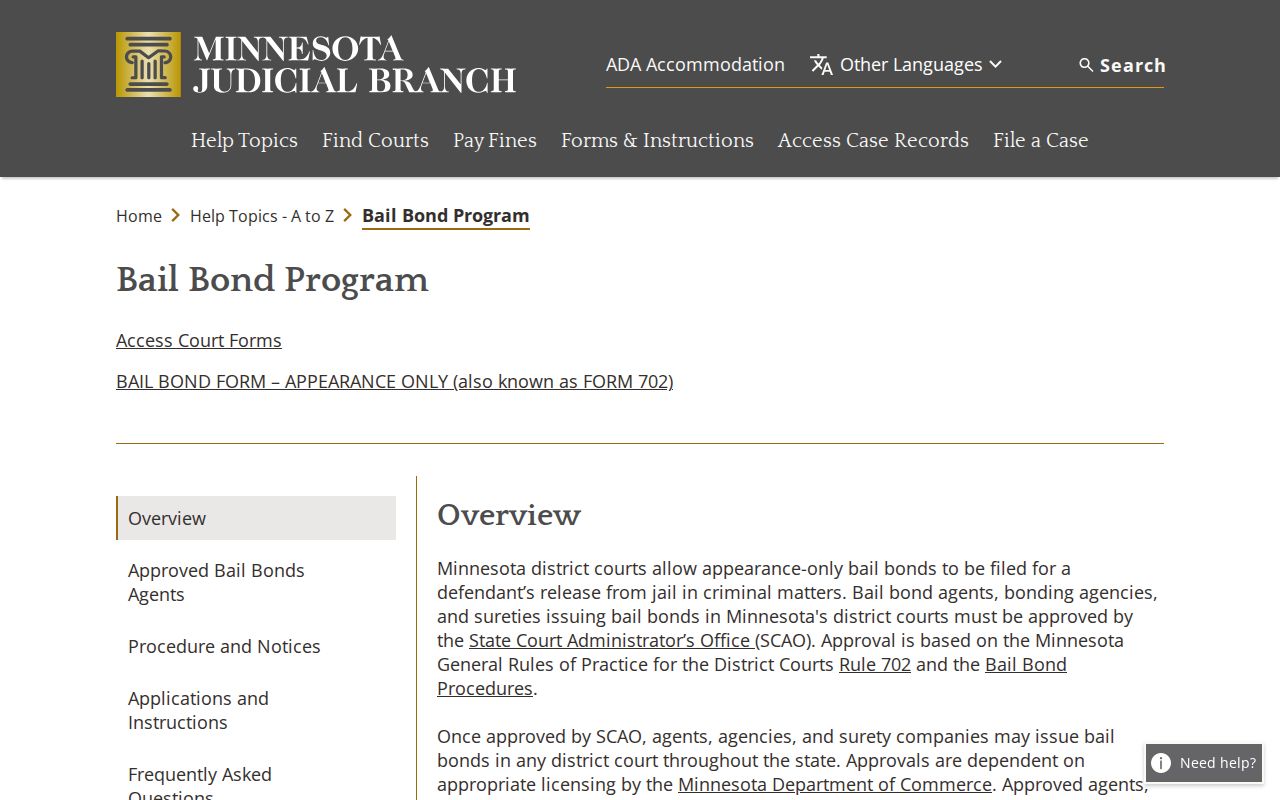
Those rules decide who may post a bond for a Murray County arrest warrant.
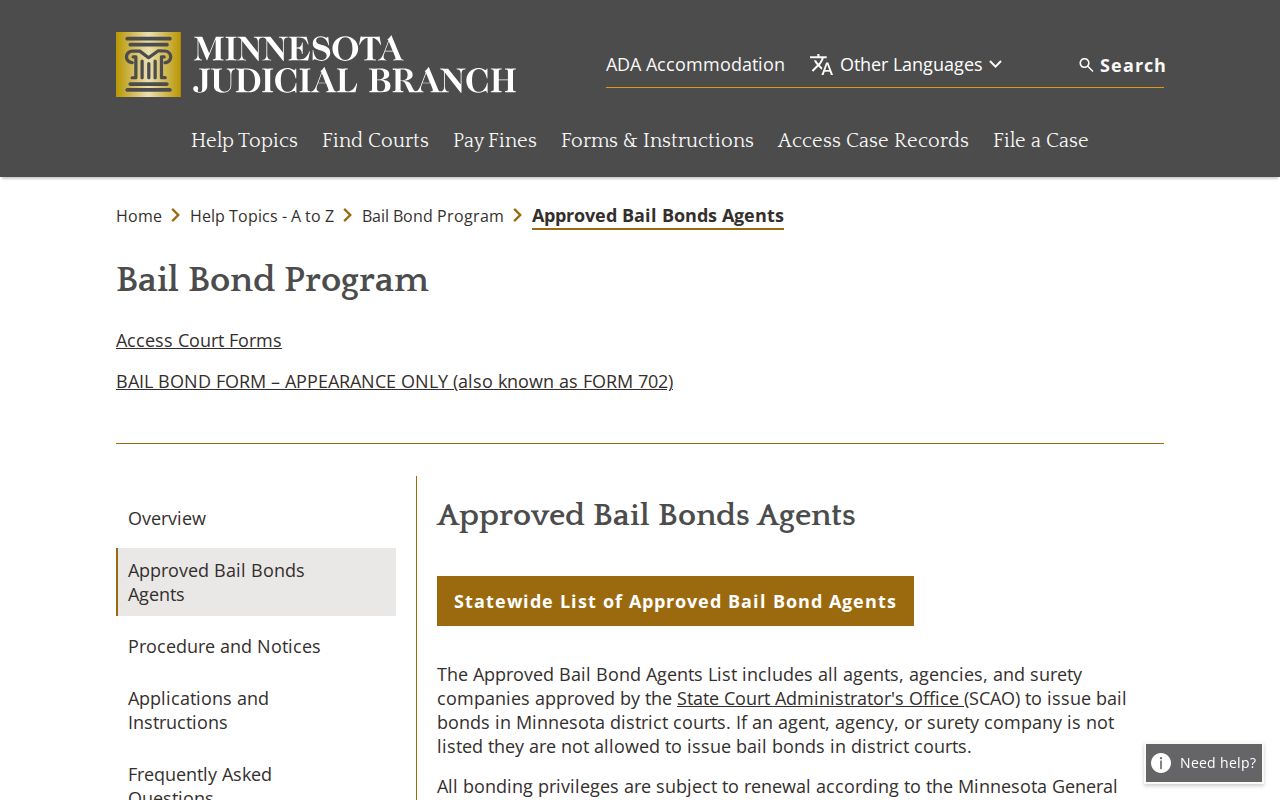
The approved-agent list is the place to check a name before paying anyone.